

Fifty years after the first military governor of Benue-Plateau State, Commissioner of Police Joseph Dechi Gomwalk was executed after he was implicated in the Lt. Col. Bukar Sukar Dimka bloody coup of 1976, Plateau State is still battling to have a leader who has his vision and foresight for the state.
Till today, Joseph Gomwalk, or fondly referred to as JD Gomwalk, remains the architect of the modern Plateau we all enjoy today, and a highly celebrated and respected figure for his rapid and impactful development of the state.
Gomwalk was a visionary leader who saw the future and set up lasting structures that have withstood the test of time and become everlasting legacies that many leaders have struggled to reach up to or even dream of surpassing.
His legacies and ideals are not only visible for all to see but have become a standard leadership rating while remaining forever etched in the hearts of Plateau people.

The reforms he carried out as the governor in just eight years and the infrastructural revolution in his tenure have remained unmatched, while subsequent governors have struggled to ride on his rather large shoulders, even in death.
JD Gomwalk’s progressive leadership established enduring institutions like the University of Jos, the Nigerian Standard Newspaper, the Jos Terminus Market, the Jos Wildlife Park, the Jos City Bus Service, the Jos Metropolitan Development Board, JMDB, to ensure organised and controlled development of the capital city of the state, the Plateau Hotel, the Jos-Bukuru Water project, the Benue-Plateau Investment and Properties Company, now known as the Plateau Investment and Property Development Company, PIPC, establishment of Government Colleges, staff quarters for civil servants, among a host of other lasting projects and infrastructures.
All these achievements and infrastructural developments bore testament to a man who governed like a craftsman, building not just structures but systems yet to be matched by any of his successors.
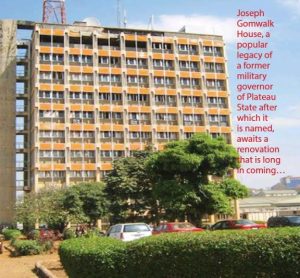
A visionary and legacy builder, JD Gomwalk saw the future and chose to build it with a blueprint of the Plateau spirit, forever etched in history. He was a leader well ahead of his time with his investments in education and infrastructure, which birthed the modern heart of the Middle Belt.
He built institutions that outlived his time and shaped the destinies of generations, and with bold conviction and deliberate actions, Gomwalk built the foundation we still stand on today; he was a trailblazer who gave Plateau State a voice and became a true legend of the Plateau.
His administration was marked not merely by the projects it launched, but by the principles that powered them. These principles consisted of education, empowerment, and enterprise.
CP Joseph Dechi Gomwalk was born in Amper in the present-day Kanke Local Government Area of Plateau State on 13 April, 1935.
According to a biography written by Anthony Goyol, JD Gomwalk was the 10th child of Rebecca and Pa Dechi Samuila, an evangelist. At the age of eight in 1943, he was enrolled at a missionary school run by the Sudan United Mission in his village, where he spent three years at the SUM Elementary School and completed the programme there in 1946. He will later be enrolled at the Gindiri Middle School, now known as Boys Secondary School, Gindiri.
He later earned a degree in Zoology from the University of Ibadan.

He was appointed the first Headboy of the school. In 1954, he won the award for Best Student of the Year in Northern Nigeria, which earned him and students from other African countries a sponsored educational trip to England.
He and 15 others were members of the first graduating class of BSS, Gindiri, in 1955, while his school scored 100% in the WAEC Examinations that year.
He was a Nigerian Police Commissioner and the first military governor of the then Benue-Plateau State, serving from 1967 until July 1975.
As the military governor, JD Gomwalk pioneered the establishment of the University of Jos after his efforts to attract Ahmadu Bello University, ABU, to open a campus in the state were stalled due to political reasons.
Not deterred, Gomwalk invited the University of Ibadan, UI, his alma mater, to open its Jos campus in November 1971, an institution that later evolved into the University of Jos. His push for higher education has lasting contributions to the state’s media and educational landscape.
In 1956, he was given admission at the Nigerian College of Arts, Science and Technology, Zaria, for a two-year course in the sciences.
During that period, the Boys’ High School Old Students Association was formed in 1957, appointing JD Gomwalk as its first president of the association, which later evolved into the Gindiri Old Students’ Association (GOSA) in 1967 and has remained so to date.
In 1958, he was given admission by the University of Ibadan to study Zoology, with specialised training in Parasitology. His education at the university was funded by the Northern Nigerian Government scholarship, of which he was a beneficiary.

Joseph Gomwalk graduated from the University of Ibadan in 1961 with first-class Honours (B.Sc.) in Zoology, specialising in Parasitology, and given his outstanding performance, the then Northern Nigerian Government offered him an appointment with the Ministry of Animal and Forest Resources as an entomologist in 1961.
The Nigeria Police Force had Gomwalk and Selcan Miner added to their number in 1966 following the appeal by the Northern Nigerian Government to have adequate representation in the force, with two men each from the thirteen provinces of the Northern government. Gomwalk and Miner were the men to fill the quota of Plateau Province in the Police Force.

Gomwalk was also the first black Divisional Officer for Mambilla Plateau and was behind the construction of the road that links Gembu of Mambilla Plateau to the rest of Nigeria today.
As the Governor of Benue-Plateau, JD Gomwalk created a lot of ‘firsts’ especially in the field of education, civil service, communication, employment, construction, and agriculture.
Education, across all levels, became Gomwalk’s utmost commitment. Civil servants in the state were regularly enrolled in courses to ensure effectiveness in their service to the state.
The number of primary, secondary, and tertiary institutions of learning increased on a yearly basis, and the general education of the populace was also taken into consideration by the creation of home economics, health, and sanitary education programmes for the general public.
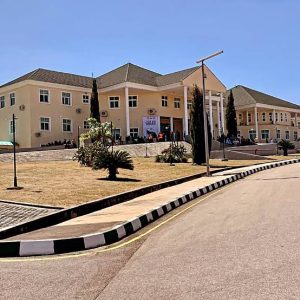
His push for higher education has lasting contributions to the state’s media and educational landscape.
Beyond institutions, Gomwalk built people as well. Between 1970 and 1973, he launched several empowerment programmes for civil servants and supported over 3,000 entrepreneurs, farmers, and traders across the old Benue-Plateau, creating a new generation of indigenous business leaders, many of whom went on to anchor the region’s economy long after his demise. His leadership was ‘people-first’ long before the phrase became a cliché; a belief that governance should not only build roads but also open doors.
Communication was also a vital part of his government and administration, and it mattered that even the very least of the projects undertaken by his government was clearly communicated to every member of the state.

This led to the creation and establishment of the Nigerian Standard Newspaper in 1972, the Benue-Plateau Television in 1974, which later became NTA Jos in 1977 when it was taken over by the Federal Government.
JD Gomwalk saw it as a means through which ideas and news could be disseminated and the culture of the various ethnic groups projected, with the purpose being to foster the much-desired unity through eradicating ignorance and preventing misunderstanding among the various ethnic groups in the state.
Monumental edifices in Jos that bear the imprint of the legendary JD Gomwalk include the Joseph Gomwalk Secretariat, the Nigeria Standard building, a nine-storey building named after him, the Central Bank branch in Jos, Joseph Gomwalk Street, Jos Plaza Hotel, Abattoir, Government College, and a host of others.
A detrabilized Nigerian, JD Gomwalk, played a vital role during and after the Nigerian-Biafran civil war, where he ensured that the properties of Igbo residents in the state were safeguarded for their reclamation by the rightful owners after the war, and also ensured certain costs were paid accordingly.
Sadly, JD Gomwalk’s life was cut short when he was implicated in Dimka’s failed coup of 13 February, 1976. He was tried by a military tribunal, convicted, and executed by firing squad on 15 May 1976. Some later accounts and commentators have, however, questioned his actual involvement in the coup, citing inconsistencies in the evidence against him and the rushed manner in which the judgment and his execution were carried out.

On May 15, 1976, at just 41 years old, Joseph Dechi Gomwalk was executed by firing squad, and in that singular act, a dreamer was silenced, but never defeated.
He did not live to see the final stones laid on some of his most ambitious projects. The University of Jos, which he fought so hard to establish, came to life and full autonomy the same year he was executed. The Nigeria Standard Newspaper, which he founded in 1972, became one of Northern Nigeria’s most respected voices in journalism, just like he had envisioned.
He did not witness the completion of the Jos Terminus Ultra-Modern Market, which he had envisioned to be the largest in sub-Saharan Africa, nor did he live to see the Jos International Breweries blossom into an industrial landmark, nor the stadium project along Zaria Road that would later symbolise Plateau’s sporting pride.
He did not see the economic seeds he planted in over 3,000 small and medium businesses empowered under his administration mature into the foundations of Plateau’s indigenous enterprise.
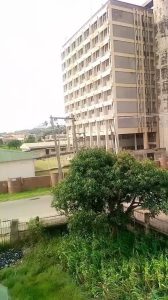
And yet, his vision has endured. Every brick, every book, every byline that carries the Plateau name bears traces of JD Gomwalk’s blueprint. His legacy was not left in monuments alone, but in momentum; in the idea that leadership must be defined by service, not survival.
Decades after his death, the Joseph Gomwalk Secretariat still hums with government activity; the University of Jos continues to educate thousands from every corner of Nigeria; and the Standard Building, still standing proud in West of Mines, remains a testament to his belief that Plateau must always have a voice.
Historians will not forget a remark he once made while giving a speech:
“We cannot talk of progress if the people’s hands are empty,” he had said.
Those remarks have outlived him and revealed the vision behind the projects he embarked upon. Those remarks were the dream behind the roads he built, the schools he established, and the systems he set up to empower the masses.
JD Gomwalk filled a young state’s empty hands with possibility, and today, Plateau remembers the legend who never left. Time has a way of fading names from the nation’s memory, but JD Gomwalk’s name can never be obliterated from the Plateau.
Among the hills and red earth that once echoed his footsteps, Joseph Dechi Gomwalk is not a forgotten governor. He is a legend, and he is family.